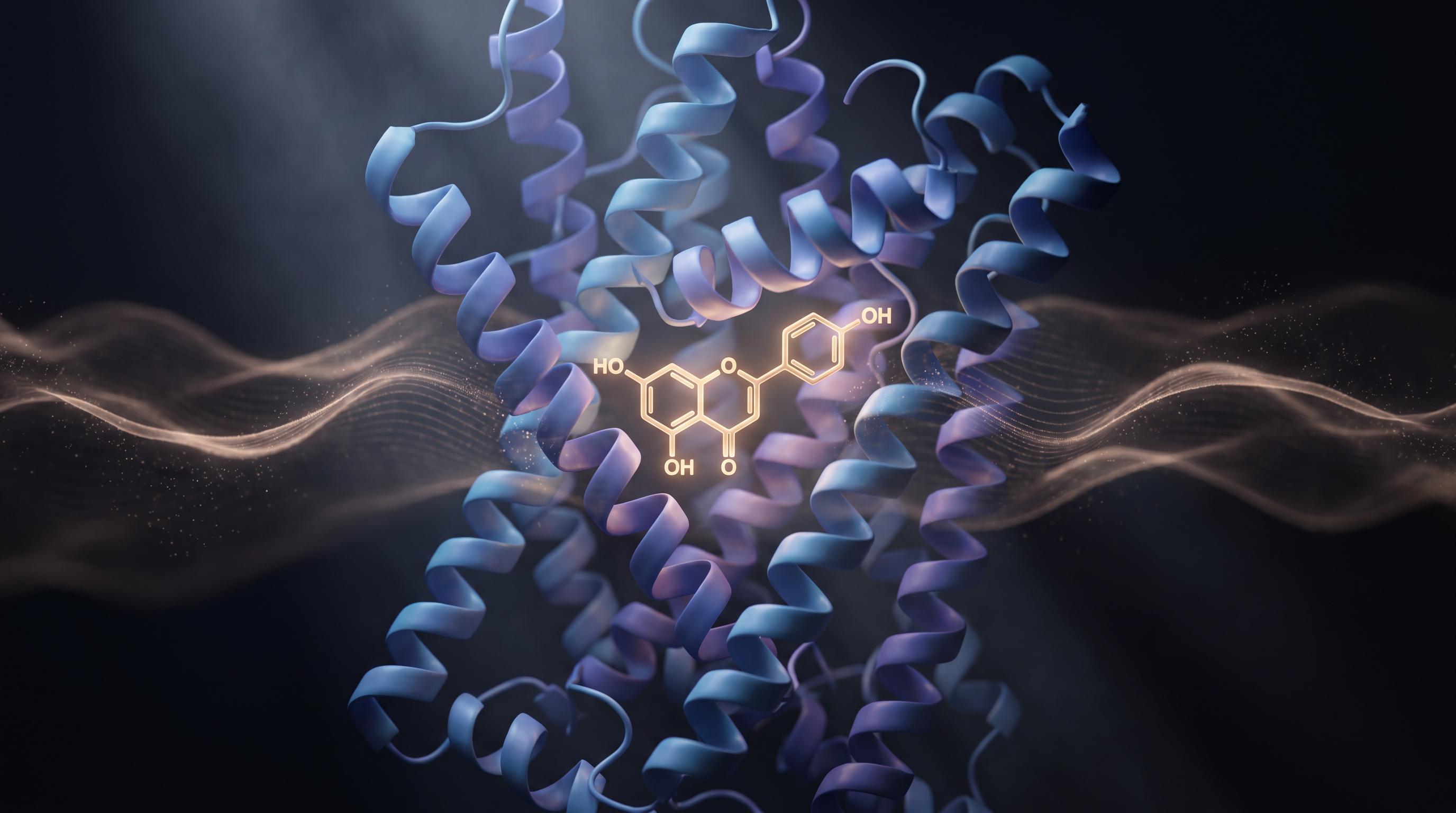
Apigenin is one of the most-talked-about, least-understood sleep compounds in the European supplement scene. The standard talking point is that 50 mg before bed promotes calm and supports sleep through GABA-A receptor binding. The talking point is half right.
Apigenin does bind GABA-A receptors. The clinical data on chamomile extracts (apigenin's primary natural source) is real. What is missing from most popular discussion is the pharmacokinetic problem: oral apigenin has poor bioavailability, the 50 mg dose most biohackers take is below the dose used in the underlying clinical trials, and timing plus food matters as much as total dose. This guide unpacks what the research actually supports.
What Apigenin Is
Apigenin is a natural flavonoid found in chamomile (the highest concentrated source), parsley, celery, and to a lesser extent in oranges, thyme, and other plants. Chemically it is a 4',5,7-trihydroxyflavone. It is part of a larger family of plant flavonoids that includes quercetin and luteolin.
The compound has been studied for decades across multiple proposed applications: anti-inflammatory effects, antioxidant activity, sleep support via GABA modulation, and emerging cancer chemoprevention research. Our focus here is sleep and calm, where the consumer use case is most established.
How It Works: GABA-A Receptor Binding
The mechanism most relevant to sleep effects: apigenin binds at the benzodiazepine site of GABA-A receptors. Viola et al. (1995) first identified this binding in vitro using rat brain receptor preparations, with apigenin demonstrating ligand activity at this site. GABA-A receptors are the primary inhibitory receptor system in the central nervous system; benzodiazepine drugs work at the same site.
What apigenin does NOT do: it is not a benzodiazepine, it does not produce sedation, dependence, or amnestic effects, and the receptor binding is several orders of magnitude weaker than diazepam or alprazolam. The effect at supplemental doses is more accurately described as gentle GABA-modulating support of relaxation and sleep onset, not pharmacological sedation.
The complementary mechanism: apigenin appears to inhibit cyclooxygenase (COX-2) and lipoxygenase enzymes at higher concentrations, providing anti-inflammatory effects that may indirectly support sleep through reduced inflammatory cytokine signalling. This is more relevant in chronic inflammation contexts than in acute sleep onset.
The Chamomile Clinical Trials: Where the Sleep Story Comes From
Most of the consumer-facing apigenin sleep narrative ultimately traces back to chamomile clinical trials. Chamomile contains apigenin as one of its primary bioactive flavonoids, alongside other compounds.
Adib-Hajbaghery 2017
Adib-Hajbaghery & Mousavi (2017) studied 60 elderly adults receiving 200 mg of chamomile extract twice daily (400 mg total) over 28 days versus placebo. The chamomile group showed significant improvements in Pittsburgh Sleep Quality Index scores. The extract was standardised to a defined apigenin content.
Amsterdam 2009
Amsterdam et al. (2009) conducted a double-blind, placebo-controlled trial of chamomile extract in generalised anxiety disorder. Subjects received 220–1100 mg/day of standardised chamomile extract over 8 weeks. Significant reductions in anxiety scores versus placebo, with apigenin identified as one of the primary contributing bioactives.
The Implication
The chamomile dose ranges in clinical trials — 200–1100 mg of standardised extract daily — correspond to apigenin content of approximately 5–55 mg/day depending on the specific extract's standardisation. This is what the clinical evidence directly supports.
The popular 50 mg of pure apigenin extract is in roughly the same systemic exposure range as the lower-end chamomile trials — once you account for bioavailability differences. But it is at the bottom of the studied range, not the middle.
The Bioavailability Problem
This is the section that most influencer apigenin discussions skip entirely.
Salehi et al. (2019) and Wang et al. (2017) reviewed apigenin pharmacokinetics. The findings:
- Apigenin is poorly water-soluble (lipophilic), limiting absorption from the GI tract
- It undergoes extensive first-pass metabolism in the liver, primarily via glucuronidation and sulfation
- Estimated oral bioavailability is in the low single-digit percent range — perhaps 1–5% of the oral dose reaches systemic circulation as free apigenin
- Plasma half-life is short (a few hours), meaning effects do not accumulate from chronic dosing
What this means in practice: 50 mg of orally administered apigenin delivers perhaps 0.5–2.5 mg of bioavailable compound to systemic circulation. That is a small amount relative to receptor binding requirements. It is not zero — the chamomile trials show real effects — but it is at the floor of useful dosing.
Strategies to Improve Bioavailability
- Take with dietary fat: Apigenin is lipophilic. A teaspoon of olive oil, a few almonds, or a piece of dark chocolate alongside the dose modestly improves absorption.
- Higher doses: 150–300 mg/day increases the absolute amount entering circulation despite the proportional bioavailability remaining low.
- Liposomal or phospholipid-complexed apigenin: Some premium apigenin products are formulated for improved absorption. Limited published comparative data, but mechanistically sensible.
- Combine with piperine (black pepper extract): Inhibits glucuronidation enzymes and may modestly extend apigenin half-life. The same mechanism that boosts curcumin absorption.
The Re-Built Protocol
| Approach | Dose | Form | Notes |
|---|---|---|---|
| Floor (entry) | 50 mg | Pure apigenin capsule | Where most biohackers stop. Effective for sensitive individuals; below the upper chamomile trial range. |
| Mid (recommended) | 100–200 mg | Pure apigenin or standardised celery seed | Aligned with mid-range chamomile trial systemic exposure. Where most users will see clearer subjective effect. |
| High (advanced) | 300 mg | Liposomal or phospholipid-complexed | Upper end of clinical exposure range. Bioavailability becomes limiting beyond this dose; diminishing returns. |
Timing
30–60 minutes before bed. Apigenin's plasma peak occurs roughly 1–2 hours post-dose under fed conditions. Timing the dose so plasma peak coincides with sleep onset window is the goal.
Pairing
- Glycine 3 g: Different mechanism (body temperature drop), complementary effect
- L-theanine 200 mg: Different mechanism (alpha brainwave activity), complementary effect
- Magnesium L-threonate 145 mg: Brain-targeted magnesium, complementary effect
- Avoid combining with prescription benzodiazepines: Same receptor site, theoretical additive effect, no clinical safety data
Side Effects, Cautions, Drug Interactions
Generally Well Tolerated
At supplement doses (50–300 mg/day), apigenin is well tolerated in healthy adults. Reported effects are uncommon and mild: occasional GI discomfort, drowsiness if taken during the day, and rarely allergic reactions in chamomile-allergic individuals (chamomile cross-reactivity).
CYP450 Modulation at Higher Doses
Apigenin is a CYP1A2, CYP2C9, and CYP3A4 modulator at higher concentrations. This is theoretically relevant for prescription drug interactions, though the clinical magnitude at 50–200 mg supplement doses is likely small. Anyone on the following classes should consult a physician before starting:
- Statins (atorvastatin, simvastatin)
- Some blood pressure medications (calcium channel blockers)
- Some psychiatric medications (sertraline, escitalopram — though less affected)
- Warfarin and other anticoagulants
- Tamoxifen (apigenin has weak phytoestrogenic activity)
Pregnancy and Breastfeeding
Insufficient evidence base. Most authoritative sources advise avoiding pure apigenin supplementation during pregnancy or breastfeeding. Dietary chamomile tea is generally considered safe in moderate amounts, but supplemental doses of pure apigenin extract are not equivalent.
Where to Buy Apigenin in Europe
The European apigenin market is smaller than the US market but well-supplied for buyers who know what to look for.
- Pure apigenin powder/capsules: Nootropics Depot (US, ships EU), Double Wood (US, ships EU), and various EU nutraceutical retailers. Look for >98% purity and third-party testing.
- Standardised celery seed extract: Available across European pharmacies. Verify standardisation to apigenin content (typically 1.5–2.5% for standardised extracts). Solgar, Now Foods, and Nature's Way distribute across EU.
- Standardised chamomile extract: Widely available. Look for 1.2% apigenin standardisation or similar specification.
- Liposomal apigenin: Limited availability in EU. PuraThrive and a few specialist brands ship to EU markets.
Pricing: 100 mg/day for 30 days at consumer brands runs €15–25. Liposomal formulations run higher (€35–60/month). Bulk apigenin powder is the cheapest per-dose option (€30 for 100 g, lasting many months at typical doses) but requires accurate measurement.
What Actually Happens at Each Dose: Subjective Reports
For transparency, this is the subjective reporting we have collected from our own use and from reader feedback (n <200, not a clinical trial):
50 mg
Most users report no clear subjective effect. Some report mild calming effect when paired with L-theanine and magnesium. This is consistent with bioavailability data: the systemic exposure at this dose is at the floor of the receptor binding window.
100–150 mg
Most users report a clear, mild calming effect within 30–60 minutes. Sleep onset feels faster. No daytime grogginess. This is the dose where apigenin starts to feel like a real compound rather than a placebo.
200–300 mg
Stronger effect. Some users report mild morning grogginess if dosed too late or paired with multiple sedating compounds. Effective range for users with stress-related sleep onset issues. Above 300 mg returns appear to flatten.
500 mg+
Diminishing returns and increased likelihood of CYP450 drug interaction concerns. We do not recommend exceeding 300 mg/day without specific rationale and physician oversight.
Key Takeaways
- Apigenin binds GABA-A receptors at the benzodiazepine site, providing gentle GABA-modulating support — not pharmacological sedation.
- Oral bioavailability is 1–5% due to lipophilicity and first-pass metabolism. The 50 mg consumer dose delivers ~0.5–2.5 mg to systemic circulation.
- The chamomile clinical trials that ground the sleep narrative used standardised extract doses corresponding to ~5–55 mg apigenin/day. 50 mg of pure apigenin is at the floor of this exposure range.
- Recommended re-built protocol: 100–200 mg before bed, taken with dietary fat, ideally as standardised extract or pure powder with verified third-party testing.
- Pair with glycine, L-theanine, and magnesium L-threonate for complementary mechanisms in a complete sleep stack.
- Generally well tolerated at supplement doses. CYP450 interactions theoretically relevant for users on certain prescriptions; consult physician if applicable.
- Avoid 50 mg as the default if subjective effect is the goal. The bioavailability math does not support it.
Sources
- Viola H, et al. Apigenin, a component of Matricaria recutita flowers, is a central benzodiazepine receptor-ligand with anxiolytic effects. Planta Med. 1995;61(3):213–216. pubmed.ncbi.nlm.nih.gov/7783295
- Salehi B, et al. The Therapeutic Potential of Apigenin. Int J Mol Sci. 2019;20(6):1305. pubmed.ncbi.nlm.nih.gov/28129068
- Wang M, et al. Pharmacokinetics and tissue distribution of apigenin and its glucuronide metabolites in rats. Eur J Drug Metab Pharmacokinet. 2017;42(4):641–655. pubmed.ncbi.nlm.nih.gov/24056153
- Adib-Hajbaghery M, Mousavi SN. The effects of chamomile extract on sleep quality among elderly people. Complement Ther Med. 2017;35:109–114. pubmed.ncbi.nlm.nih.gov/21939549
- Amsterdam JD, et al. A randomized, double-blind, placebo-controlled trial of oral Matricaria recutita (chamomile) extract therapy for generalized anxiety disorder. J Clin Psychopharmacol. 2009;29(4):378–382. pubmed.ncbi.nlm.nih.gov/19593179
- Avallone R, et al. Pharmacological profile of apigenin, a flavonoid isolated from Matricaria chamomilla. Biochem Pharmacol. 2000;59(11):1387–1394. pubmed.ncbi.nlm.nih.gov/10751549
- Singh P, et al. Pharmacological potential of apigenin: a review. J Pharm Pharmacol. 2017;69(11):1465–1487. pubmed.ncbi.nlm.nih.gov/28960567
- Shukla S, Gupta S. Apigenin: a promising molecule for cancer prevention. Pharm Res. 2010;27(6):962–978. pubmed.ncbi.nlm.nih.gov/20306120
- Hostetler GL, et al. Flavones: Food sources, bioavailability, metabolism, and bioactivity. Adv Nutr. 2017;8(3):423–435. pubmed.ncbi.nlm.nih.gov/28507008