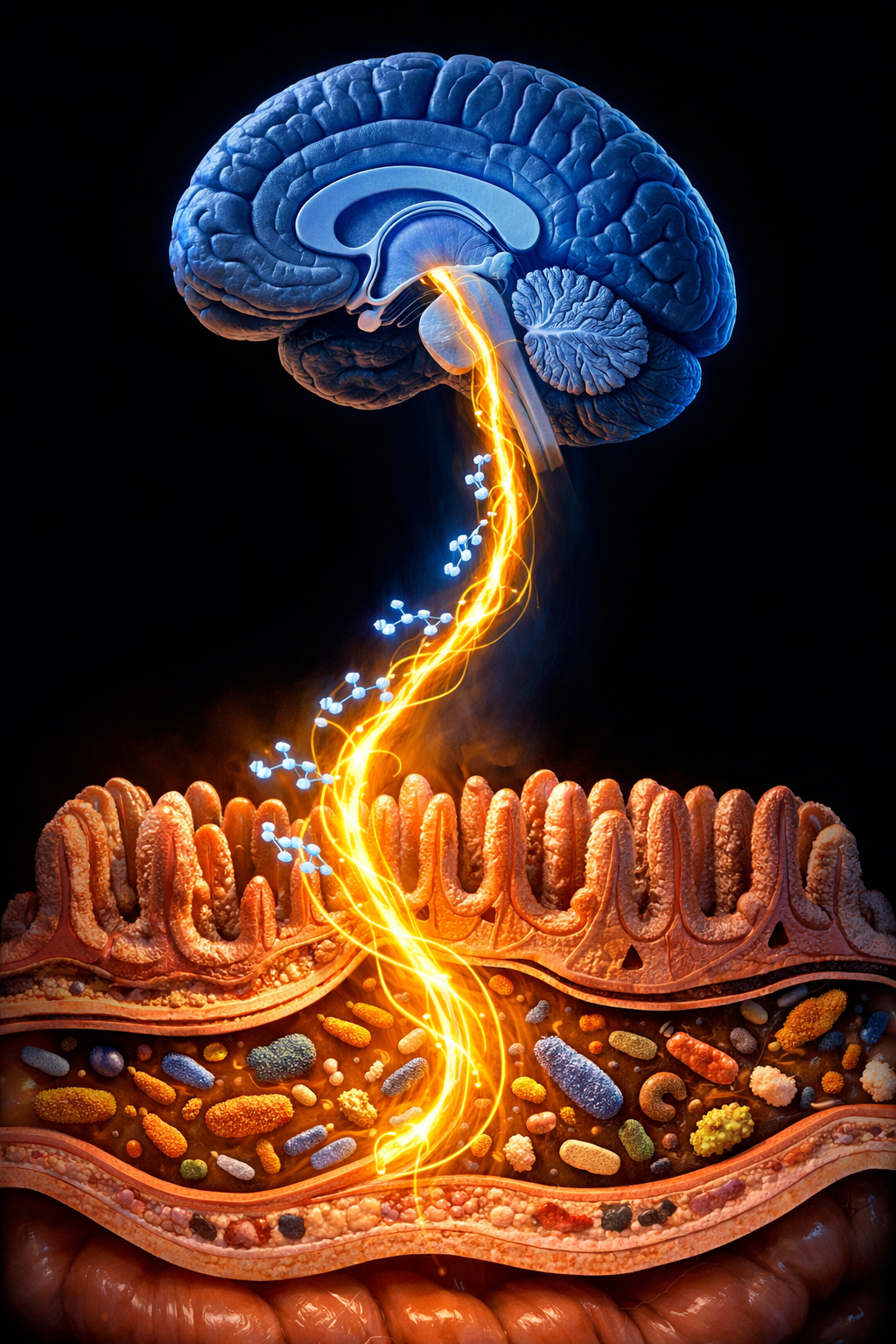
Approximately 90% of your serotonin is produced in the gut. Not the brain — the gut. The enteric nervous system embedded in the walls of your gastrointestinal tract contains roughly 500 million neurons, more than the spinal cord. The vagus nerve, the primary communication highway between gut and brain, transmits about four times as many signals upward (gut to brain) as downward (brain to gut).
The implications are significant. “Brain fog,” low mood, chronic anxiety, and impaired cognitive performance are frequently attributed to neurological or psychological causes. In many cases, the upstream driver is the gut. A damaged intestinal lining, a dysbiotic microbiome, or chronically elevated gut-derived inflammation can systematically degrade cognitive function through pathways that no nootropic or antidepressant can address if the gut source is not treated first.
This guide covers the gut-brain axis mechanism and the four compounds with the strongest published evidence for repairing it — all available as supplements across Europe.
The Gut-Brain Axis: How It Works
The gut-brain axis is a bidirectional communication network connecting the central nervous system (CNS) to the enteric nervous system (ENS) via neural, endocrine, immune, and metabolic pathways. Understanding the mechanism is essential for understanding why these specific compounds work.
The Enteric Nervous System: Your Second Brain
The ENS is embedded in the walls of the gastrointestinal tract and operates largely independently of the brain. It regulates gut motility, enzyme secretion, blood flow, and immune responses without requiring brain input. Its 500 million neurons use over 30 neurotransmitters, including 95% of the body’s total serotonin. When the ENS is disrupted — by dysbiosis, inflammation, or barrier damage — these neurotransmitter signals become aberrant and the vagal communication to the brain is corrupted.
The Vagus Nerve: The Superhighway
The vagus nerve is the longest cranial nerve in the body, running from the brainstem to the abdomen and innervating the heart, lungs, and digestive tract. It is the primary physical channel through which the gut communicates with the brain. Critically, approximately 80% of vagal fibres carry afferent (sensory) signals — meaning they carry information from the gut to the brain, not instructions from the brain to the gut. The gut is not a passive recipient of brain commands; it is an active reporting system.
The Microbiome and Psychobiotics
The gut microbiome — the several trillion microorganisms living in the GI tract — produces neurotransmitters and their precursors, including serotonin, GABA, dopamine precursors, and short-chain fatty acids (SCFAs). Specific bacterial strains have been shown to modulate anxiety and mood through vagal signalling and direct metabolite production. The term “psychobiotics” was coined to describe probiotic strains with demonstrable effects on brain function and mental health.
Intestinal Permeability and Systemic Inflammation
A healthy intestinal lining is a selective barrier — it absorbs nutrients and blocks pathogen entry. When tight junction proteins between enterocytes (gut lining cells) are damaged, the barrier becomes permeable. Bacterial lipopolysaccharides (LPS), food antigens, and other contents of the intestinal lumen leak into systemic circulation. This triggers a chronic low-grade inflammatory response that crosses the blood-brain barrier via cytokine signalling, contributing directly to neuroinflammation, sickness behaviour, depressive symptoms, and cognitive impairment. The mechanism is well-established in published research.
Compound 1: L-Glutamine (5–10g/day)
L-glutamine is a conditionally essential amino acid and the primary fuel source for enterocytes, the cells lining the intestinal wall. Under conditions of stress, poor diet, illness, or overtraining, glutamine demand exceeds the body’s synthesis capacity. Enterocyte function degrades, tight junction proteins weaken, and intestinal permeability increases.
Supplemental glutamine restores enterocyte energy availability, supports the synthesis of tight junction proteins (particularly occludin and zonulin family proteins), and reduces intestinal permeability. Rapin & Wiernsperger (2010) in Clinics reviewed the evidence for intestinal barrier dysfunction and its role in systemic inflammation, highlighting glutamine’s central role in barrier maintenance. Multiple clinical trials confirm that glutamine supplementation reduces permeability markers in patient populations with inflammatory bowel conditions and in athletes under high training load.
For gut-brain axis repair, L-glutamine is the foundational compound. Without a functional intestinal barrier, all other interventions are addressing downstream consequences of a persistent upstream problem. Standard dosing for gut repair is 5–10g per day, taken in the morning on an empty stomach to maximise delivery to enterocytes before other macronutrients compete for absorption.
L-glutamine is available as a food supplement across all EU member states, is inexpensive in bulk powder form, and has an excellent safety profile at these doses. It is tasteless and dissolves readily in water.
Compound 2: Butyrate (300–600mg/day)
Butyrate is a short-chain fatty acid (SCFA) produced primarily by bacterial fermentation of dietary fibre in the colon. It is the preferred energy source for colonocytes — the cells of the large intestinal lining — and plays a critical role in maintaining colon health, regulating the gut immune system, and producing anti-inflammatory signals.
Its relevance to the gut-brain axis operates through several mechanisms. First, butyrate directly strengthens the intestinal barrier by upregulating the expression of tight junction proteins, reducing permeability. Second, it exerts potent anti-inflammatory effects in the gut via NF-κB pathway inhibition, reducing the production of pro-inflammatory cytokines. Third, and most relevant to brain function, butyrate activates vagus nerve signalling pathways, providing direct neurological signals from the gut to the brain that modulate mood, satiety, and cognitive state.
In populations with low dietary fibre intake — which describes the majority of European adults, given average EU fibre consumption falls well below the recommended 25–30g/day — endogenous butyrate production is insufficient. Supplemental sodium butyrate or calcium butyrate at 300–600mg/day bridges this gap. Both forms are available as capsule supplements in the EU and are legal food supplements without restriction.
Compound 3: Psychobiotics (Specific Probiotic Strains)
Not all probiotic supplements have psychobiotic effects. The strain specificity here is critical — “probiotic” is not a functional category for mood or cognition unless the specific strains with published evidence are present. A generic “10 billion CFU” probiotic containing random lactobacillus strains will not reliably produce gut-brain axis effects.
Lactobacillus rhamnosus
Lactobacillus rhamnosus (specifically strain JB-1) is the most extensively studied psychobiotic strain. It produces GABA directly in the gut — the primary inhibitory neurotransmitter — and modulates brain GABA receptor expression via the vagus nerve. The landmark animal study by Bravo et al. (2011) in PNAS demonstrated that L. rhamnosus JB-1 reduced anxiety behaviour and altered GABA receptor distribution in the brain, with effects abolished by vagotomy — confirming the vagal pathway. Human studies have since demonstrated anxiety reduction and improved stress response markers.
Bifidobacterium longum
Bifidobacterium longum (strain 1714) has demonstrated cortisol reduction and improved mood in human trials. Messaoudi et al. (2011) in Br J Nutr conducted a double-blind, placebo-controlled trial showing that a combination including B. longum reduced urinary cortisol output and self-reported anxiety in healthy volunteers. The effect on the HPA axis (hypothalamic-pituitary-adrenal axis, the cortisol regulation system) is consistent with gut-to-brain vagal signalling and microbiome-derived metabolite effects on stress pathways.
When selecting a psychobiotic product, look specifically for one or both of these strains at a minimum of 1–5 billion CFU each, with third-party viability testing. The supplement should be stored refrigerated and taken 30 minutes before a meal to maximise survival through stomach acid.
Compound 4: Omega-3 DHA (1–2g/day)
Omega-3 DHA is the compound that bridges both sides of the gut-brain axis simultaneously — the only compound in this guide with direct evidence on both the gut and the brain.
On the gut side, DHA and EPA exert anti-inflammatory effects on the intestinal lining through the production of specialised pro-resolving mediators (SPMs) — resolvins and protectins that actively resolve gut inflammation and support barrier integrity. Published research indicates that omega-3 supplementation reduces intestinal permeability markers and modulates gut microbiome composition in favour of SCFA-producing bacteria.
On the brain side, DHA is the primary structural fatty acid in neuronal membranes, as detailed in our omega-3 guide. It is required for synaptic membrane fluidity, neuroinflammation resolution, and long-term neuroplasticity. Every neurological signal transmitted from the gut via the vagus nerve is received and processed by neurons whose function depends on adequate DHA availability.
The compound that repairs the gut side of the gut-brain axis is the same compound that optimises the brain side. At 1–2g DHA per day from a quality rTG fish oil or algae oil source, taken with a fat-containing meal, omega-3 DHA is simultaneously the most versatile and most evidence-backed compound in the gut-brain axis protocol. It is available as a food supplement across all EU member states without restriction.
What Damages the Gut-Brain Axis
Understanding the protocol also requires understanding what works against it. The following factors are primary drivers of gut-brain axis disruption and should be minimised alongside supplementation:
- Processed food and low dietary fibre: Eliminates fermentable substrate for SCFA-producing bacteria. The resulting butyrate deficit damages the colonic lining and reduces anti-inflammatory signalling.
- Chronic psychological stress: Directly increases intestinal permeability through CRH (corticotropin-releasing hormone) signalling to mast cells in the gut wall. Stress and gut damage reinforce each other in a feedback loop.
- NSAIDs (ibuprofen, aspirin, naproxen): Damage the intestinal lining through COX inhibition, reducing prostaglandin-mediated mucosal protection. Even short-term use can increase permeability measurably.
- Alcohol: Directly toxic to enterocytes and tight junction proteins. Moderate to heavy consumption significantly increases intestinal permeability and systemic LPS exposure.
- Artificial sweeteners: Studies suggest several artificial sweeteners — particularly saccharin and sucralose — alter gut microbiome composition and may impair glucose tolerance via microbiome-mediated pathways.
- Antibiotic overuse: Broad-spectrum antibiotics cause significant and sometimes prolonged disruption to microbiome diversity, reducing psychobiotic strain populations and SCFA production.
The Full Protocol: Daily Schedule
| Time | Compound | Dose | Notes |
|---|---|---|---|
| Morning (empty stomach) | L-Glutamine | 5–10g | Dissolve in water, 30min before eating |
| Psychobiotic probiotic | As labelled (1–5B CFU) | 30min before breakfast | |
| With meals (AM and PM) | Omega-3 DHA | 1–2g DHA/day (split) | With fat-containing meals for absorption |
| Evening (with dinner) | Sodium/calcium butyrate | 300–600mg | Enteric-coated; with food |
Allow 4–8 weeks to see meaningful changes in gut-brain axis function. Intestinal lining repair, microbiome remodelling, and vagal signalling normalisation are gradual processes. Improvements in mood stability, reduced brain fog, and better stress resilience are typically the first reported benefits. Digestive comfort and bowel regularity often improve within 2–3 weeks.
Combining this protocol with adequate dietary fibre (25–30g/day from vegetables, legumes, and whole grains) substantially amplifies the butyrate effect by providing substrate for endogenous SCFA production. Supplementation and diet work together, not in place of each other.
Sources
- Rapin JR, Wiernsperger N. Possible Links between Intestinal Permeability and Food Processing: A Potential Therapeutic Niche for Glutamine. Clinics (Sao Paulo). 2010;65(6):635–643. pubmed.ncbi.nlm.nih.gov/20439992
- Bravo JA, et al. Ingestion of Lactobacillus strain regulates emotional behavior and central GABA receptor expression in a mouse via the vagus nerve. Proc Natl Acad Sci USA. 2011;108(38):16050–16055. pubmed.ncbi.nlm.nih.gov/21876150
- Messaoudi M, et al. Assessment of psychotropic-like properties of a probiotic formulation (Lactobacillus helveticus R0052 and Bifidobacterium longum R0175) in rats and human subjects. Br J Nutr. 2011;105(5):755–764. pubmed.ncbi.nlm.nih.gov/21419557
- Cryan JF, et al. The Microbiota-Gut-Brain Axis. Physiol Rev. 2019;99(4):1877–2013. pubmed.ncbi.nlm.nih.gov/31460832
- Daulatzai MA. Non-celiac gluten sensitivity triggers gut dysbiosis, neuroinflammation, gut-brain axis dysfunction, and vulnerability for dementia. CNS Neurol Disord Drug Targets. 2015. pubmed.ncbi.nlm.nih.gov/26295583
- Bhatt DL, et al. Cardiovascular Risk Reduction with Icosapentaenoic Acid for Hypertriglyceridemia. N Engl J Med. 2019;380(1):11–22. (Omega-3 anti-inflammatory mechanisms.) pubmed.ncbi.nlm.nih.gov/30415628
- Peng L, et al. Butyrate enhances the intestinal barrier by facilitating tight junction assembly via activation of AMP-activated protein kinase in Caco-2 cell monolayers. J Nutr. 2009;139(9):1619–1625. pubmed.ncbi.nlm.nih.gov/19625695
- Sherwin E, et al. A gut (microbiome) feeling about the brain. Curr Opin Gastroenterol. 2016;32(2):96–102. pubmed.ncbi.nlm.nih.gov/26760301