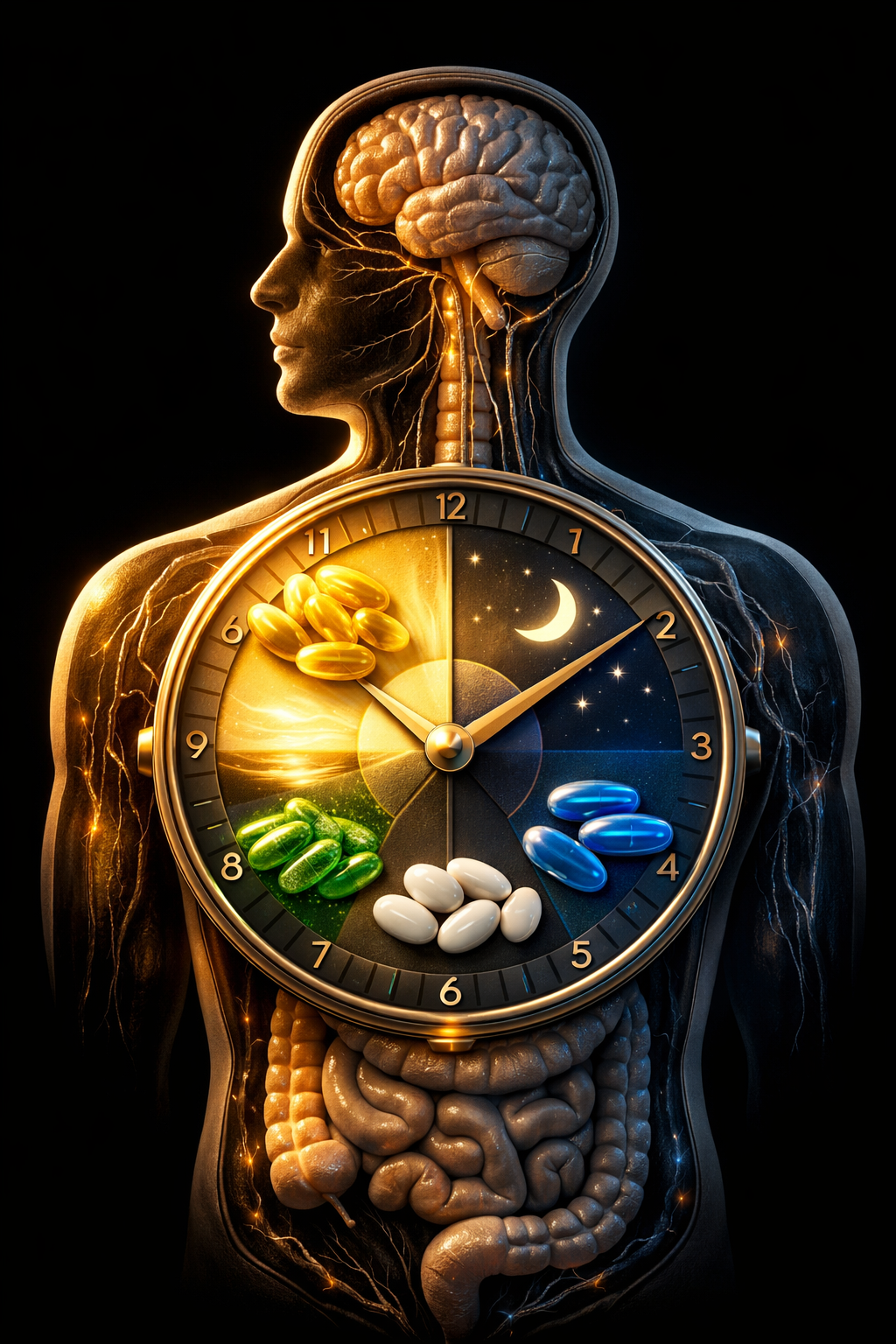
You researched the best forms. You compared bioavailability data. You bought from quality brands. Then you took everything at breakfast with your morning coffee and cancelled half the benefits before you even left the house.
Timing is the most systematically overlooked variable in supplementation. It is not a minor detail. The difference between optimal and suboptimal timing can determine whether a supplement is absorbed at 20% or 80% efficiency — whether it competes with another compound you took ten minutes earlier, whether it helps or hinders sleep, whether the concentration peak aligns with the work you need it for.
This guide covers the published evidence on timing for every major supplement category. The goal is not to turn your morning into a complex pharmaceutical schedule — it is to identify the few timing decisions that have the largest impact and make them automatic.
Morning: Empty Stomach (30 Minutes Before Food)
Certain supplements require an empty stomach to achieve optimal absorption. This is because food in the digestive system either physically competes for the same absorption transporters, or because the pH change and bile acid release triggered by eating impairs the supplement’s stability or uptake mechanism.
Iron
Iron is the canonical example of food-timing sensitivity. Non-haem iron (the form found in supplements and plant foods) is absorbed via the divalent metal transporter-1 (DMT-1) in the duodenum. Multiple dietary factors severely impair this process. Hallberg et al. (1989) in Am J Clin Nutr demonstrated that calcium simultaneously present in the gut reduces iron absorption by 50–60%. Coffee and tea tannins reduce it by 60–80% (see the coffee section below). Phytates in cereal and legumes reduce it by 50–80%.
Conversely, vitamin C (ascorbic acid) dramatically enhances non-haem iron absorption by reducing ferric (Fe3+) to ferrous (Fe2+) iron, the form transportable by DMT-1. The practical rule: take iron on an empty stomach with a glass of water or diluted orange juice (vitamin C source), at least 1 hour before coffee and 2 hours before any calcium-containing food or supplement. This single timing change can double bioavailability.
Zinc
Zinc absorption is substantially impaired by phytates — the anti-nutrient compounds found in grains, legumes, nuts, and seeds. Lönnerdal (2000) in J Nutr reviewed the evidence showing phytate:zinc molar ratios in typical Western diets reduce zinc absorption by 40–50% relative to an empty stomach or low-phytate meal. Zinc picolinate and zinc bisglycinate are better-absorbed chelated forms, but even these are affected by phytate competition.
Additionally, zinc competes with copper at the same transporter (see the Competing Compounds section). Take zinc on an empty stomach, at least 30 minutes before food. Do not take it with iron or calcium — all three compete for overlapping transporters.
L-Glutamine
As covered in our gut-brain axis guide, L-glutamine is the primary fuel for enterocytes — the cells lining the intestinal wall. Taking it on an empty stomach maximises delivery to the intestinal lining before other macronutrients compete for absorption and transit space. Dissolve 5–10g in water and consume 30 minutes before breakfast.
Probiotics
Probiotic survival through stomach acid is the primary determinant of effective dosing. Stomach acid is most dilute and transit time is fastest on an empty stomach with water — conditions that maximise bacterial survival to the small intestine. Studies comparing probiotic administration timing consistently show greater viable count delivery when taken 30 minutes before a meal versus during or after. For psychobiotic strains (Lactobacillus rhamnosus, Bifidobacterium longum), timing on an empty stomach is particularly relevant given the high dose required to produce neurological effects.
Morning: With a Fat-Containing Meal
Fat-soluble compounds require dietary fat for micelle formation in the small intestine — the physical structure that enables them to cross the intestinal wall. Without dietary fat, absorption of fat-soluble vitamins falls dramatically. The implication is clear: never take fat-soluble supplements with a fat-free meal or on an empty stomach.
Vitamin D3 + K2
Vitamins D3 and K2 are both fat-soluble and require co-ingestion with dietary fat for meaningful absorption. Dawson-Hughes et al. (2015) in J Acad Nutr Diet confirmed that vitamin D3 absorption was approximately 32% greater when taken with a high-fat meal (30g fat) compared to a fat-free meal. A meal containing at least 10–15g of dietary fat — eggs, olive oil, avocado, cheese, nuts — is sufficient. The K2 (MK-7 form) should be taken at the same time, as both require the same absorption pathway and their functions are complementary (D3 raises calcium absorption; K2 directs calcium to bone rather than arteries).
Omega-3 DHA/EPA
Omega-3 fatty acids are themselves fats, but their absorption is still enhanced by a fatty meal. This is because the presence of dietary fat stimulates bile acid and pancreatic lipase release, which is required for omega-3 processing. A 2019 study found EPA bioavailability was approximately 60% greater when taken with a high-fat meal versus a fasted state. For those taking 2g+ EPA+DHA per day, split the dose between morning and evening meals — this reduces fishy reflux and avoids exceeding the gut’s fat processing capacity in a single sitting.
Vitamin A, Vitamin E, CoQ10
All three are fat-soluble and follow the same rule. Vitamin A (retinol or beta-carotene) absorption is near-negligible from fat-free meals — studies show beta-carotene bioavailability from fat-free meals approaches zero. CoQ10 in ubiquinol form (the reduced, more bioavailable form) has improved but still fat-dependent absorption; some manufacturers formulate it in an oil base to compensate, but a fat-containing meal remains the optimal context. Vitamin E (mixed tocopherols) similarly requires fat for micellar incorporation.
Afternoon: Pre-Focus and Pre-Workout
Creatine Monohydrate — 5g/day
Despite extensive research and marketing around “creatine timing,” the evidence is clear: timing matters far less than consistency. A 2013 study compared pre-workout versus post-workout creatine timing and found marginal differences at best. The dominant finding across the literature is that daily consistent intake is what saturates muscle and brain phosphocreatine stores — the timing within the day is secondary. Take it whenever is easiest for you to remember, whether that is morning with breakfast, pre-workout, or post-workout.
Caffeine + L-Theanine
The combination should be taken 20–40 minutes before the cognitive or physical performance task it is intended to support, as this aligns peak plasma concentration with the demand period. Caffeine has a half-life of 5–6 hours in most adults, which means afternoon doses (post-2pm) will meaningfully impair sleep onset for people with average metabolic clearance. If cognitive demands are primarily morning or early afternoon, keep the caffeine dose before 1pm. L-theanine 200mg with 100mg caffeine — the research-validated 2:1 ratio — reduces the jitteriness and cardiovascular side effects of caffeine while preserving and enhancing the alertness benefit.
Rhodiola Rosea
Rhodiola is an adaptogen with an onset of approximately 30 minutes to 2 hours post-ingestion, making timing more relevant than with most adaptogens. For anti-fatigue effects before a demanding afternoon work session or physical training, taking rhodiola 30–60 minutes prior is appropriate. Rhodiola is mildly stimulating and activating — unlike ashwagandha, which is calming — and should not be taken late in the evening. Morning or early afternoon is the optimal window.
Evening: Calming, Recovery, and Cortisol Management
Magnesium Glycinate or Magnesium L-Threonate
Magnesium’s calming and sleep-promoting effects make evening timing the most effective window. Magnesium modulates NMDA receptor activity, reduces neuronal hyperexcitability, and supports GABA function — all mechanisms relevant to sleep onset and quality. Taking it 1–2 hours before bed allows absorption and plasma peak to align with the sleep preparation period. Magnesium glycinate is the preferred form for pure sleep and relaxation support; magnesium L-threonate (Magtein) crosses the blood-brain barrier more effectively and is preferred when the cognitive neuroplasticity benefits are a primary goal alongside sleep.
Do not take magnesium simultaneously with calcium or iron — all three compete for intestinal absorption pathways (see competing compounds below). If you take calcium for bone health, separate it from your magnesium evening dose by at least 2 hours.
Ashwagandha KSM-66
Ashwagandha’s primary evidence-based benefit is cortisol reduction and HPA axis normalisation. The Chandrasekhar et al. (2012) trial in Indian J Psychol Med demonstrated significant reductions in serum cortisol and perceived stress with 300mg KSM-66 twice daily. For individuals using ashwagandha primarily for sleep quality and evening relaxation, the PM dose is the more important one. It pairs well with magnesium glycinate in an evening protocol. Some users find ashwagandha mildly sedating; for those individuals, avoiding morning dosing is advisable.
Phosphatidylserine
Phosphatidylserine blunts the cortisol response to cognitive and physical stress. When the goal is reducing the cortisol elevation that occurs from a full workday or intense training session, taking PS in the afternoon or evening — after the main stress exposure — is logical. A dose of 300mg in the evening also supports the natural cortisol decline that should occur as you approach sleep, where chronic evening cortisol elevation is a common contributor to poor sleep onset.
Compounds That Compete: Separate by 2+ Hours
This section covers the most commonly violated rule in supplement protocols. Multiple widely-taken supplements compete for the same intestinal absorption transporters. Taking them simultaneously does not simply average the absorption of both — it can dramatically reduce the bioavailability of one or both.
| Compound A | Compound B | Competition Mechanism | Separation Required |
|---|---|---|---|
| Calcium | Magnesium | Compete for the same divalent cation transporters in the intestine | 2+ hours |
| Calcium | Iron | Calcium directly inhibits non-haem and haem iron absorption (Hallberg 1989) | 2+ hours |
| Zinc | Copper | High-dose zinc supplementation induces metallothionein, which binds copper and prevents its absorption. Long-term zinc use without copper monitoring depletes copper stores. | 4+ hours, or supplement copper separately |
| Iron | Zinc | Both use DMT-1 transporter; compete at high relative concentrations | 2+ hours |
| Calcium | Zinc | Calcium reduces zinc absorption (shared divalent pathway) | 2+ hours |
| Fat-soluble vitamins (A, D, E, K) | Each other (at very high doses) | Compete for micellar incorporation at very high doses; not typically an issue at supplemental doses | Generally not required at standard doses |
The most clinically significant of these interactions is zinc depleting copper. Many people supplement zinc at 25–50mg/day for immune function, testosterone, or skin health without supplementing copper. Over months, this can produce a copper deficiency that causes anaemia, neurological symptoms, and connective tissue problems. If taking more than 25mg zinc daily, supplement 1–2mg copper separately — ideally at a different time of day.
The Coffee and Tea Rule
Coffee and tea deserve a dedicated section because their timing interference is both widespread and underappreciated. Both beverages contain polyphenols — chlorogenic acids in coffee, tannins in tea — that bind to mineral cations and significantly impair absorption.
Hallberg & Rossander (1984) in Hum Nutr Appl Nutr demonstrated that tea consumed with a meal reduced non-haem iron absorption by approximately 62%. Coffee reduced it by approximately 35%. Both effects operate through polyphenol chelation of iron in the intestinal lumen. The inhibitory effect persists for 1 hour after consumption — it is not limited to co-ingestion timing.
The practical rule: wait at least 1 hour after your morning coffee or tea before taking iron or zinc supplements. Do not take these minerals within 1 hour before or after coffee or tea. For people taking iron therapeutically (iron deficiency anaemia is common in European women, and rates of deficiency across the EU are significant), this timing correction can be as impactful as doubling the dose.
The Complete Daily Timing Schedule
| Window | Supplement | Rationale |
|---|---|---|
| Morning, empty stomach (30min before food) | Iron + vitamin C | Maximises non-haem iron absorption; vitamin C enhances |
| Zinc picolinate | Avoids phytate competition from food | |
| L-Glutamine | Feeds enterocytes before macronutrients compete | |
| Probiotics | Maximises stomach acid survival; take 30min before eating | |
| Morning, with fatty meal | Vitamin D3 + K2 | Fat-soluble; requires 10–15g dietary fat |
| Omega-3 DHA/EPA (AM dose) | Fat-soluble; bile acid stimulation from fat improves absorption | |
| Vitamin A, Vitamin E | Fat-soluble; same rule as D3 | |
| CoQ10 (ubiquinol) | Fat-soluble; ideally in oil-based formulation or with fat | |
| Afternoon / pre-work | Caffeine + L-Theanine | 20–40min before cognitive task; keep before 1pm for sleep |
| Creatine monohydrate 5g | Timing flexible; consistency matters more than exact window | |
| Rhodiola rosea | 30–60min before demanding work; avoid evening (activating) | |
| Evening meal | Omega-3 DHA/EPA (PM dose) | Splits daily dose; reduces reflux vs single large AM dose |
| Sodium/calcium butyrate | Enteric-coated; with food supports tolerability | |
| Phosphatidylserine 300mg | Cortisol blunting post-day stress; supports sleep preparation | |
| 1–2 hours before bed | Magnesium glycinate or L-Threonate | Aligns peak with sleep onset; calming GABA/NMDA effects |
| Ashwagandha KSM-66 | Cortisol reduction; pairs with magnesium for wind-down |
The Simplification: Start With the Rules That Matter Most
If the table above is overwhelming, apply these three rules first. They cover the majority of the impact:
- Rule 1: All fat-soluble vitamins with food that contains fat. D3, K2, A, E, omega-3, CoQ10. Never on an empty stomach.
- Rule 2: Iron and zinc away from calcium, coffee, and each other. Separate each by 2 hours minimum. Take on an empty stomach with water.
- Rule 3: Magnesium in the evening. 1–2 hours before bed. Away from calcium.
Everything else — the caffeine timing window, the probiotic pre-meal rule, the rhodiola afternoon protocol — layers on top of these fundamentals and optimises further. But the three rules above will capture 80% of the timing benefit for the typical supplement protocol.
Sources
- Hallberg L, et al. The role of vitamin C in iron absorption. Int J Vitam Nutr Res Suppl. 1989;30:103–108. pubmed.ncbi.nlm.nih.gov/2598544
- Hallberg L, Rossander L. Effect of different drinks on the absorption of non-haem iron from composite meals. Hum Nutr Appl Nutr. 1982;36(2):116–123. pubmed.ncbi.nlm.nih.gov/6402915
- Lönnerdal B. Dietary factors influencing zinc absorption. J Nutr. 2000;130(5S):1378S–1383S. pubmed.ncbi.nlm.nih.gov/11115792
- Dawson-Hughes B, et al. Dietary fat increases vitamin D-3 absorption. J Acad Nutr Diet. 2015;115(2):225–230. pubmed.ncbi.nlm.nih.gov/25441954
- Chandrasekhar K, et al. A Prospective, Randomized Double-Blind, Placebo-Controlled Study of Safety and Efficacy of a High-Concentration Full-Spectrum Extract of Ashwagandha Root in Reducing Stress and Anxiety in Adults. Indian J Psychol Med. 2012;34(3):255–262. pubmed.ncbi.nlm.nih.gov/23439798
- Antonio J, Ciccone V. The effects of pre versus post workout supplementation of creatine monohydrate on body composition and strength. J Int Soc Sports Nutr. 2013;10:36. pubmed.ncbi.nlm.nih.gov/23919405
- Hallberg L, et al. Calcium: effect of different amounts on nonheme- and heme-iron absorption in humans. Am J Clin Nutr. 1991;53(1):112–119. pubmed.ncbi.nlm.nih.gov/1984332
- Fischer Walker C, Black RE. Zinc and the risk for infectious disease. Annu Rev Nutr. 2004;24:255–275. (Zinc-copper interaction reviewed.) pubmed.ncbi.nlm.nih.gov/15189122
- Bravo JA, et al. Ingestion of Lactobacillus strain regulates emotional behavior and central GABA receptor expression in a mouse via the vagus nerve. PNAS. 2011. (Probiotic timing for survival referenced.) pubmed.ncbi.nlm.nih.gov/21876150
- Owen GN, et al. The combined effects of L-theanine and caffeine on cognitive performance and mood. Nutr Neurosci. 2008;11(4):193–198. pubmed.ncbi.nlm.nih.gov/18681988