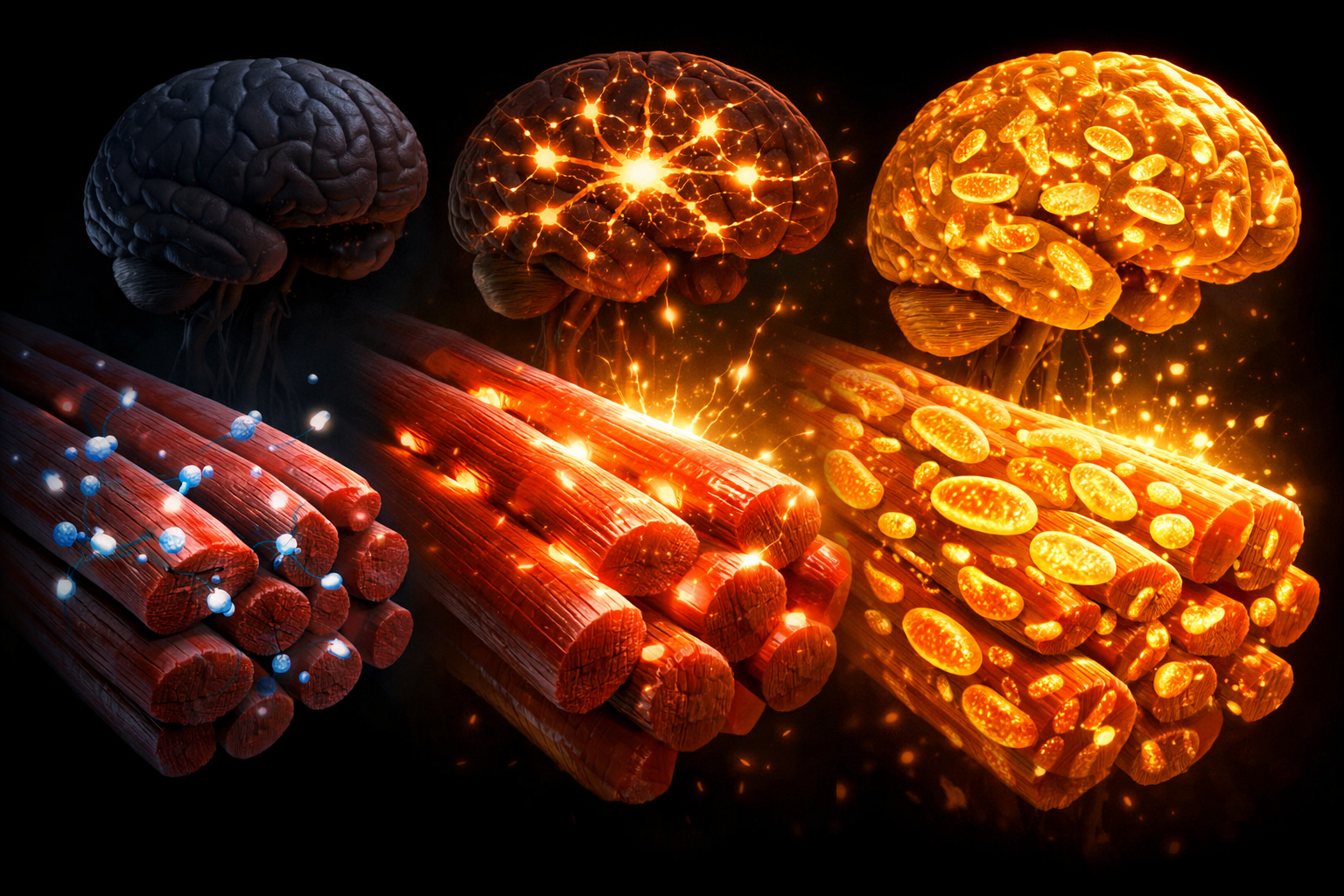
Creatine monohydrate is the most studied performance supplement in existence, with over 500 peer-reviewed studies accumulated across four decades. The evidence is consistent, reproducible, and covers a wider range of physiological systems than most people realise. It is not just a muscle supplement. Its effects on the brain, mitochondria, and cellular energy recycling are documented in published literature and build cumulatively over months.
Most people who start creatine do not have a clear picture of what to expect and when. They notice they feel heavier in the first week and wonder if it is working. They do not know that the cognitive effects require several months of tissue saturation to become measurable. This guide maps the timeline with specificity: what happens at each stage, which mechanisms are driving it, and what the research says about the magnitude of those effects.
The protocol throughout this guide is 5 g of creatine monohydrate per day, taken consistently. No loading phase is required — this point is addressed directly in the myths section.
The Biochemistry You Need to Understand First
Creatine's entire mechanism rests on one molecule: adenosine triphosphate (ATP). ATP is the universal energy currency of every cell in your body. When a cell performs work — a muscle fibre contracting, a neuron firing, a mitochondrion pumping ions — it breaks ATP into ADP (adenosine diphosphate), releasing the energy stored in the phosphate bond.
Creatine is stored in cells as phosphocreatine. When ATP is depleted rapidly, phosphocreatine donates its phosphate group to ADP, instantly regenerating ATP. This is the phosphocreatine shuttle — the fastest energy regeneration system in biology. It operates in the first 10–15 seconds of high-intensity effort, before glycolysis and oxidative phosphorylation can fully engage.
Supplementing creatine increases total intracellular creatine stores (both free creatine and phosphocreatine) by approximately 20–40% above baseline. This expanded reservoir means cells can sustain high-intensity output longer before depleting their immediate energy supply. The effect is not unique to muscle. Neurons, which are among the most energy-demanding cells in the body, also use phosphocreatine for rapid ATP regeneration, which is why creatine's cognitive effects are real and measurable in the right conditions.
Weeks 1–2: Saturation Begins, Water Weight, Cell Volumisation
The first two weeks of creatine supplementation at 5 g/day involve the initial uptake of creatine into muscle tissue via creatine transporter proteins (SLC6A8). This process is driven by sodium and chloride co-transport, meaning creatine enters muscle cells alongside water molecules. The result is measurable intracellular water retention.
The Water Weight Reality
Most people gain 1–2 kg of scale weight in the first one to two weeks of creatine supplementation. This weight is water, held within muscle cells. It is not fat, and it is not subcutaneous bloating. Creatine-driven water retention is intracellular — water is drawn into the muscle cell itself, which is precisely the mechanism behind cell volumisation.
Cell volumisation is not merely cosmetic. Research published in journals including the Journal of Strength and Conditioning Research indicates that increased muscle cell volume is itself an anabolic signal. A more hydrated muscle cell has a different gene expression profile than a dehydrated one. The cell senses its own swelling as a signal to increase protein synthesis and reduce protein breakdown. This is a genuine physiological effect, not a marketing claim.
Phosphocreatine Stores Begin Loading
At 5 g/day without a loading protocol, muscle creatine stores are estimated to reach approximately 60–80% of their maximum by the end of week two. The ascent is gradual but consistent. Performance improvements at this stage may be minimal or absent — the stores are loading, not yet fully loaded. This is the phase where many people conclude creatine "is not working" and give up.
Weeks 3–4: Phosphocreatine Stores Fully Loaded, Strength Gains Measurable
By the end of the third to fourth week at 5 g/day, muscle phosphocreatine stores are approaching or at maximum saturation. This is where measurable performance differences begin to appear for most people.
High-Intensity Performance Effects
The effect of creatine on high-intensity, short-duration exercise is among the most replicated findings in sports science. A meta-analysis by Branch (2003) in the International Journal of Sport Nutrition and Exercise Metabolism examined 22 studies and found creatine supplementation produced a mean improvement of 8% in maximum strength and 14% in the number of repetitions performed at a given load. These are not marginal effects.
The mechanism is direct: more phosphocreatine available means more ATP can be regenerated during those first 10–15 seconds of maximum effort. In practice, this translates to completing one or two additional repetitions at a given weight before failure, recovering faster between sets, and sustaining power output through longer sprint efforts.
Brain ATP Recycling: The Early Cognitive Signal
By weeks three and four, creatine has also accumulated in brain tissue, though accumulation in the central nervous system is slower than in skeletal muscle due to the blood-brain barrier and lower transporter density. Dechent et al. (1999) demonstrated using phosphorus MRS that oral creatine supplementation raises total brain creatine levels by approximately 5–10% after four weeks. The effect on cognitive performance in the general population at this stage is modest — it becomes more pronounced under conditions of stress, sleep deprivation, or dietary restriction.
Research by Watanabe et al. (2002) found that creatine supplementation reduced mental fatigue and improved performance on cognitively demanding tasks following sleep deprivation. The magnitude of effect in well-rested, well-nourished individuals is smaller but present.
Month 2: Lean Mass Gains, Emerging Cognitive Benefits, Mitochondrial Density
By the five-to-eight-week mark, creatine's indirect effects on body composition become visible. The compound itself does not stimulate muscle protein synthesis directly, but it creates conditions that make training more productive. More volume completed at higher intensity per session, combined with enhanced recovery between sessions, drives a measurable difference in lean mass accrual over this period.
Lean Mass: Separating Water from Tissue
A key distinction that the research literature makes clearly: not all of the weight gained during creatine supplementation is water. Studies using body composition measurement methods that distinguish lean mass from water — including DEXA and underwater weighing — consistently find that creatine supplementation over 6–12 weeks produces additional lean tissue gains beyond what is attributable to water retention alone, when combined with resistance training.
A meta-analysis of creatine and body composition found mean increases in lean body mass of approximately 1–2 kg over six to eight weeks of creatine plus resistance training, compared to training with placebo. This is a real structural change: additional muscle protein, not water.
Mitochondrial Density and Energy Efficiency
Creatine's relationship with mitochondria is less commonly discussed but is documented in the research. Phosphocreatine and the creatine kinase enzyme system are integral to mitochondrial energy transport. Creatine acts as a shuttle, moving high-energy phosphate groups from the mitochondrial matrix (where ATP is produced by oxidative phosphorylation) to the cytosol (where ATP is consumed by cellular work).
Research in exercise physiology suggests that creatine supplementation may influence mitochondrial biogenesis indirectly through its effects on training volume and intensity. Greater training stimulus, enabled by higher phosphocreatine availability, leads over weeks to months to adaptations in mitochondrial density and oxidative capacity. This is a cascade effect: creatine enables harder training, harder training drives mitochondrial adaptations, mitochondrial adaptations improve endurance capacity at submaximal intensities.
Cognitive Benefits: Growing Evidence
By month two, brain creatine levels have reached closer to their elevated plateau. Research from Rae et al. (2003) in the Proceedings of the Royal Society B found that six weeks of creatine supplementation (5 g/day) improved working memory and intelligence test scores in a randomised, double-blind, placebo-controlled trial in healthy young adults. The effect sizes were meaningful: working memory improved by approximately 20% on assessed tasks, and processing speed showed consistent improvements.
The cognitive benefits appear to be most pronounced in populations with lower baseline creatine status: vegetarians and vegans, who consume no dietary creatine from meat and fish; older adults, whose endogenous creatine synthesis declines with age; and individuals under significant cognitive load or sleep pressure. However, benefits are not limited to these groups — they represent the high end of the response distribution.
Month 3: Full Saturation Plateau, Endurance Improvements, Elevated Brain Creatine
By the three-month mark, the system is fully saturated and stable. Muscle phosphocreatine stores are at their maximum capacity. Brain creatine levels are at their elevated plateau — approximately 5–10% above unsupplemented baseline, a meaningful increase given the brain's energy demands.
Endurance: The Underappreciated Effect
Creatine is most strongly associated with strength and power sports. Its endurance benefits are real but more conditional. The mechanism is indirect: by increasing phosphocreatine buffering capacity, creatine allows muscle cells to maintain a higher work rate before relying on glycolysis, which produces lactate. This delays the onset of the metabolic fatigue that limits sustained moderate-to-high-intensity exercise.
Additionally, research suggests that creatine enhances glycogen storage in muscle tissue. Nelson et al. (2001) found that creatine supplementation combined with carbohydrate loading increased muscle glycogen content more than carbohydrate loading alone. Greater glycogen availability directly extends endurance capacity in activities lasting more than 90 minutes.
The 5–10% Brain Creatine Elevation
The approximately 5–10% elevation in brain creatine represents a meaningful change in the brain's capacity for rapid ATP regeneration. The brain consumes approximately 20% of the body's total energy budget despite representing only 2% of body weight. Neurons operating under sustained cognitive demand deplete local ATP pools rapidly. An expanded phosphocreatine reservoir translates to greater sustained capacity before neurons must throttle activity to match energy supply.
This is the proposed mechanism behind creatine's cognitive effects: not a direct neurotransmitter effect, but an expansion of the brain's energy reserve that delays the cognitive fatigue associated with sustained mental effort. Over months of supplementation, this sustained elevation in brain creatine availability may contribute to neuroprotective effects, a hypothesis supported by emerging research in traumatic brain injury and neurodegenerative disease models.
What Happens When You Stop
Creatine stores are not retained indefinitely once supplementation ceases. Without exogenous creatine input, the body's endogenous synthesis (approximately 1–2 g/day from arginine and glycine, produced primarily in the liver and kidneys) is insufficient to maintain the elevated intracellular concentrations that supplementation achieves.
Research indicates that muscle creatine levels return to baseline in approximately four to six weeks following cessation of supplementation. The return is gradual: stores decline continuously until the endogenous production-to-consumption equilibrium is re-established at the unsupplemented baseline. During this washout period, performance returns progressively to unsupplemented levels. There is no rebound effect below baseline — you return to where you were before starting, not below it.
Brain creatine levels normalise on a similar timescale. The cognitive effects of supplementation attenuate gradually as brain creatine returns to baseline.
The practical implication: creatine is not a compound to cycle. The evidence supports continuous supplementation as the optimal protocol. The benefits are maintained only as long as stores are maintained. There is no physiological benefit to periods of non-use, and no downregulation of creatine transporters has been demonstrated at the 5 g/day dose in published literature.
Common Myths, Addressed Directly
Myth: Creatine Causes Hair Loss
This concern originates from a single study: van der Merwe et al. (2009), which found that college rugby players supplementing with creatine showed a 56% increase in serum DHT (dihydrotestosterone) after three weeks. DHT is a potent androgen associated with androgenic alopecia (pattern hair loss).
The limitations of this study are significant: it was small (20 participants), used a loading phase protocol that may not reflect typical use, and measured serum DHT — not hair follicle DHT levels, scalp DHT receptor sensitivity, or actual hair loss. No subsequent studies have replicated the DHT finding at comparable magnitude, and no clinical studies have demonstrated a link between creatine supplementation and accelerated pattern hair loss in humans. The evidence for this risk is weak and unreplicated. It cannot be ruled out entirely for individuals with high genetic sensitivity to DHT, but it is not supported by the current weight of evidence.
Myth: Creatine Damages Kidneys
This myth persists because creatine supplementation raises serum creatinine levels — a standard kidney function marker. The confusion is understandable: creatinine (the waste product measured to assess kidney function) is a metabolite of creatine. More creatine input means more creatinine output, and more creatinine in blood and urine. However, elevated creatinine from creatine supplementation is not the same as elevated creatinine from kidney dysfunction.
Multiple long-term studies in healthy adults have found no adverse effects on kidney function from creatine supplementation at standard doses. The International Society of Sports Nutrition's 2017 position stand reviewed the literature and concluded that creatine supplementation is safe in healthy individuals. People with pre-existing kidney disease should consult a physician before supplementing, but the evidence does not support kidney risk in individuals with normal renal function.
Myth: A Loading Phase Is Necessary
Loading (20 g/day for five to seven days) reaches full muscle saturation in approximately one week. Supplementing 5 g/day without loading reaches the same saturation point in approximately three to four weeks. The endpoint is identical. Loading is a time-compression strategy, not a requirement. At European creatine monohydrate prices of roughly €0.05–0.10 per 5 g serving, there is no meaningful cost argument for loading either.
Myth: Creatine Is Only for Bodybuilders
The evidence base for creatine now extends across cognitive performance, ageing, neuroprotection, and metabolic health. Vegetarians and vegans, who obtain zero dietary creatine from animal foods, show the largest cognitive response to supplementation. Older adults show meaningful muscle preservation effects. The compound's mechanism is fundamental cellular biochemistry, not specific to any one population.
The Optimal Protocol
The evidence supports a simple and permanent protocol:
- Dose: 5 g creatine monohydrate per day
- Form: Creatine monohydrate — not creatine HCl, creatine ethyl ester, or buffered creatine. Monohydrate is the most studied form by a substantial margin, and no alternative has demonstrated superior efficacy in well-controlled trials.
- Timing: Timing relative to training has been studied with inconclusive results. The consistent finding is that timing matters less than consistency. Take it at whatever time of day you will reliably remember. Post-workout timing has marginal support in some studies but is not a priority.
- With or without food: Creatine uptake is modestly enhanced when taken with carbohydrates or protein, which stimulate insulin release. Insulin enhances creatine transporter activity. This is a small effect; taking it with meals is slightly better than taking it fasted, but the difference is not large enough to make timing a priority.
- Duration: Indefinitely. There is no established basis for cycling creatine, and continuous supplementation maintains the benefits continuously.
| Timeframe | Primary Effect | What Drives It |
|---|---|---|
| Weeks 1–2 | 1–2 kg water weight increase, cell volumisation | Intracellular creatine uptake with water co-transport |
| Weeks 3–4 | Strength and power output measurably improved, early brain saturation | Phosphocreatine stores approach full saturation |
| Month 2 | Lean mass gains visible, cognitive improvements under load, mitochondrial adaptation | Enhanced training volume drives structural adaptation; brain creatine rising |
| Month 3+ | Full saturation plateau, endurance improved, brain creatine elevated 5–10% | System at maximum creatine-supplemented capacity |
| After stopping | Effects attenuate, stores return to baseline in 4–6 weeks | Endogenous synthesis insufficient to maintain supplemented levels |
Key Takeaways
- Creatine monohydrate at 5 g/day is the most evidence-backed performance supplement available, with over 500 studies across four decades.
- Muscle phosphocreatine saturation takes three to four weeks at 5 g/day without loading; loading phases reach the same endpoint in one week.
- Brain creatine increases by approximately 5–10% with sustained supplementation, with measurable cognitive benefits particularly under conditions of cognitive stress or dietary restriction.
- Lean mass gains beyond water retention occur in individuals doing resistance training, driven by the enhanced training capacity that creatine enables.
- Effects return to baseline in four to six weeks after stopping — there is no benefit to cycling and no physiological justification for stopping.
- Hair loss and kidney damage claims are not supported by the current weight of evidence in healthy adults at standard doses.
- Creatine monohydrate is the correct form. No alternative has demonstrated superiority in well-controlled trials.
Sources
- Branch JD. Effect of creatine supplementation on body composition and performance: a meta-analysis. Int J Sport Nutr Exerc Metab. 2003;13(2):198–226. pubmed.ncbi.nlm.nih.gov/12945830
- Dechent P, et al. Increase of total creatine in human brain after oral supplementation of creatine monohydrate. Am J Physiol Regul Integr Comp Physiol. 1999;277(3):R698–704. pubmed.ncbi.nlm.nih.gov/10484486
- Rae C, et al. Oral creatine monohydrate supplementation improves brain performance: a double-blind, placebo-controlled, cross-over trial. Proc Biol Sci. 2003;270(1529):2147–2150. pubmed.ncbi.nlm.nih.gov/12816545
- Watanabe A, Kato N, Kato T. Effects of creatine on mental fatigue and cerebral hemoglobin oxygenation. Neurosci Res. 2002;42(4):279–285. pubmed.ncbi.nlm.nih.gov/12049880
- Rawson ES, Volek JS. Effects of creatine supplementation and resistance training on muscle strength and weightlifting performance. J Strength Cond Res. 2003;17(4):822–831. pubmed.ncbi.nlm.nih.gov/14636102
- Nelson AG, et al. Muscle glycogen supercompensation is enhanced by prior creatine supplementation. Med Sci Sports Exerc. 2001;33(7):1096–1100. pubmed.ncbi.nlm.nih.gov/11445754
- van der Merwe J, Brooks NE, Myburgh KH. Three weeks of creatine monohydrate supplementation affects dihydrotestosterone to testosterone ratio in college-aged rugby players. Clin J Sport Med. 2009;19(5):399–404. pubmed.ncbi.nlm.nih.gov/19741313
- Kreider RB, et al. International Society of Sports Nutrition position stand: safety and efficacy of creatine supplementation in exercise, sport, and medicine. J Int Soc Sports Nutr. 2017;14:18. pubmed.ncbi.nlm.nih.gov/28615996
- Volek JS, et al. Creatine supplementation enhances muscular performance during high-intensity resistance exercise. J Am Diet Assoc. 1997;97(7):765–770. pubmed.ncbi.nlm.nih.gov/9216554
- Candow DG, et al. Creatine supplementation and aging musculoskeletal health. Endocrine. 2019;66(1):53–65. pubmed.ncbi.nlm.nih.gov/31506905
- Avgerinos KI, et al. Effects of creatine supplementation on cognitive function of healthy individuals. Exp Gerontol. 2018;108:166–173. pubmed.ncbi.nlm.nih.gov/29704637